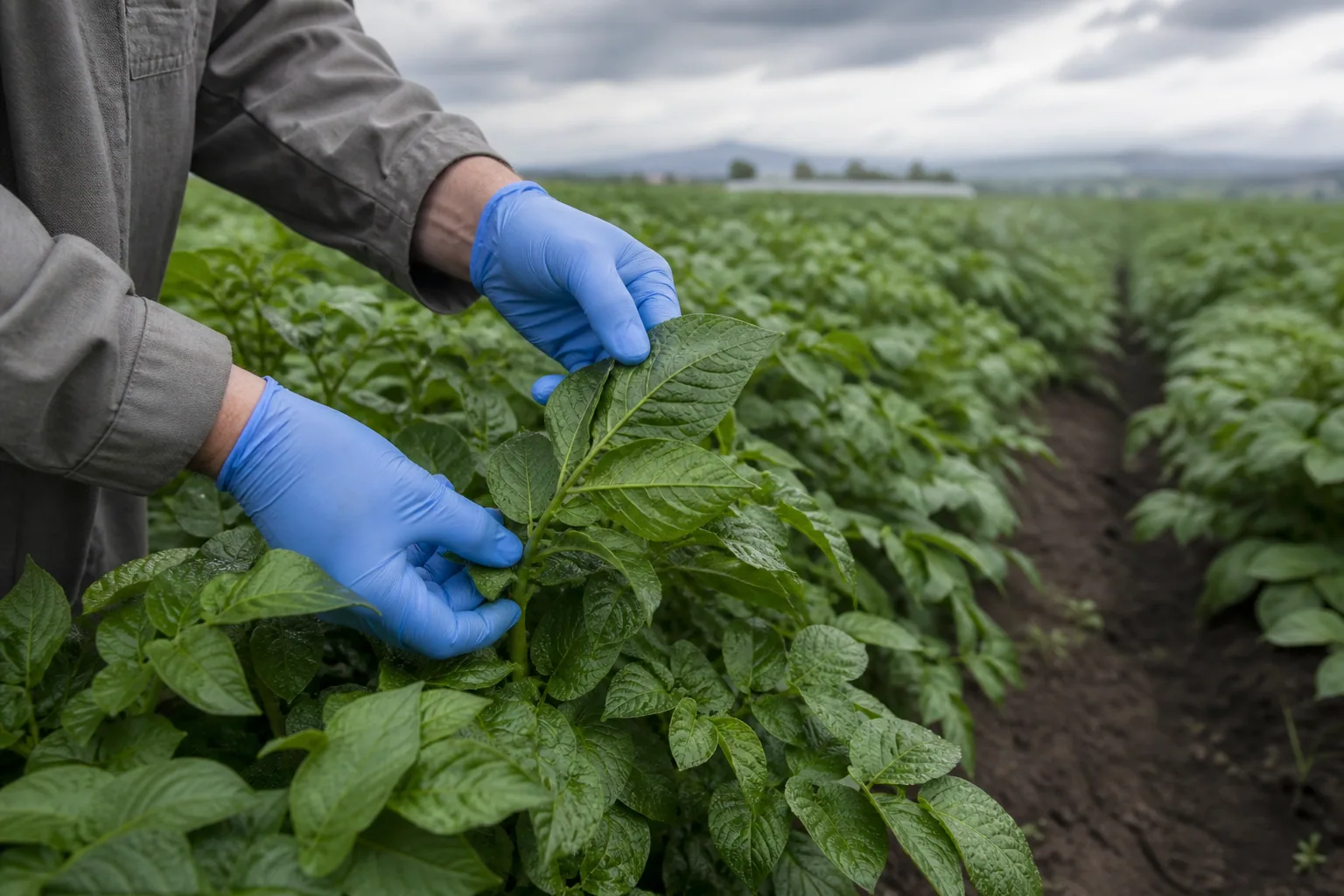
In short: the risk of potato blight increases when the pathogen is present in susceptible stock and the weather is favorable for infection for several hours. Temperature, high humidity and duration of leaf wetness must be considered together. A rainy day or a single high humidity reading is not a diagnosis by itself.
Why does the duration of leaf wetness matter?
A moist plant surface and a suitable temperature range favor the spread of the potato blight pathogen. It's not just whether it rained, but also how long the foliage stayed wet. Leaves dry more slowly in dense stands, in deeper locations or with poor air movement.
Leaf wetness can occur from rain, irrigation, dew or fog. For this reason, the daily rainfall total is a poor proxy for the infection environment by itself. A short, quickly drying shower may pose a lower risk than a dewy and humid night without precipitation.
The three necessary elements of disease
- Susceptible host plant: the resistance of the breed, the development and condition of the herd influence the risk.
- Infectious pathogen: it can come from an infected tuber, orphan plant, waste pile or surrounding stock.
- Favorable environment: suitable temperature and constant moisture are necessary for the infection process.
If any of the three are missing, there is no epidemic process. The meteorological model estimates the probability of the third element, the other two must be added with field and operational information.
What to look for after a high-risk signal?
- First go through the deeper, more humid, forested and denser patches.
- Also examine the lower and inner parts of the foliage, where drying is slower.
- Look for fast-growing, irregular, watery-green to brown leaf spots.
- In humid conditions, look at the back edge of the stain; confirm suspicious symptoms with a specialist or laboratory.
- Check for orphans, potato waste and sources of infection at the edge of the field.
Why is the signal based only on the daily average dangerous?
The daily average may mask the fact that the night was humid and wet for many hours, and the foliage quickly dried out in the afternoon. From the point of view of infection, the order of hours and the associated favorable period are important. Hourly data estimated from multiple sources can therefore provide a better early indication than a daily icon.
However, the uncertainty of the model increases if there is no on-site leaf wetness sensor, the topography is varied or the precipitation fell in torrents. Therefore, always evaluate the risk level together with the condition of the foliage on site.
Irrigation and stock structure
Irrigation in the evening to moisten the foliage can extend the wet period at night. If technology allows, the timing and method of application can reduce persistent leaf wetness. Too dense, poorly ventilated stands also dry more slowly, so the microclimate can also differ within the field.
FAQ
Does high humidity mean potato blight is certain to appear?
Not. The weather is only one of the conditions for infection. Both an infectious pathogen and a susceptible plant are needed. A high risk warrants increased monitoring and does not prove infection.
Can even a night without rain be risky?
Yes. Heavy dew, fog or persistently high humidity can create a long period of leaf wetness even without precipitation, especially in dense, poorly ventilated stands.
Does the risk model tell you when to spray?
Not by itself. The model is a warning and timing support tool. For the treatment decision, the prescription of the authorized product, the development of the plant, previous treatments, resistance management and on-site monitoring are also necessary.
Source
The limitations and practical performance of potato blight rules based on humidity and temperature are discussed in a Evaluation of Teagasc Oak Park researchers investigates. Meteon's indication is an informative estimate, not an on-the-spot diagnosis.
