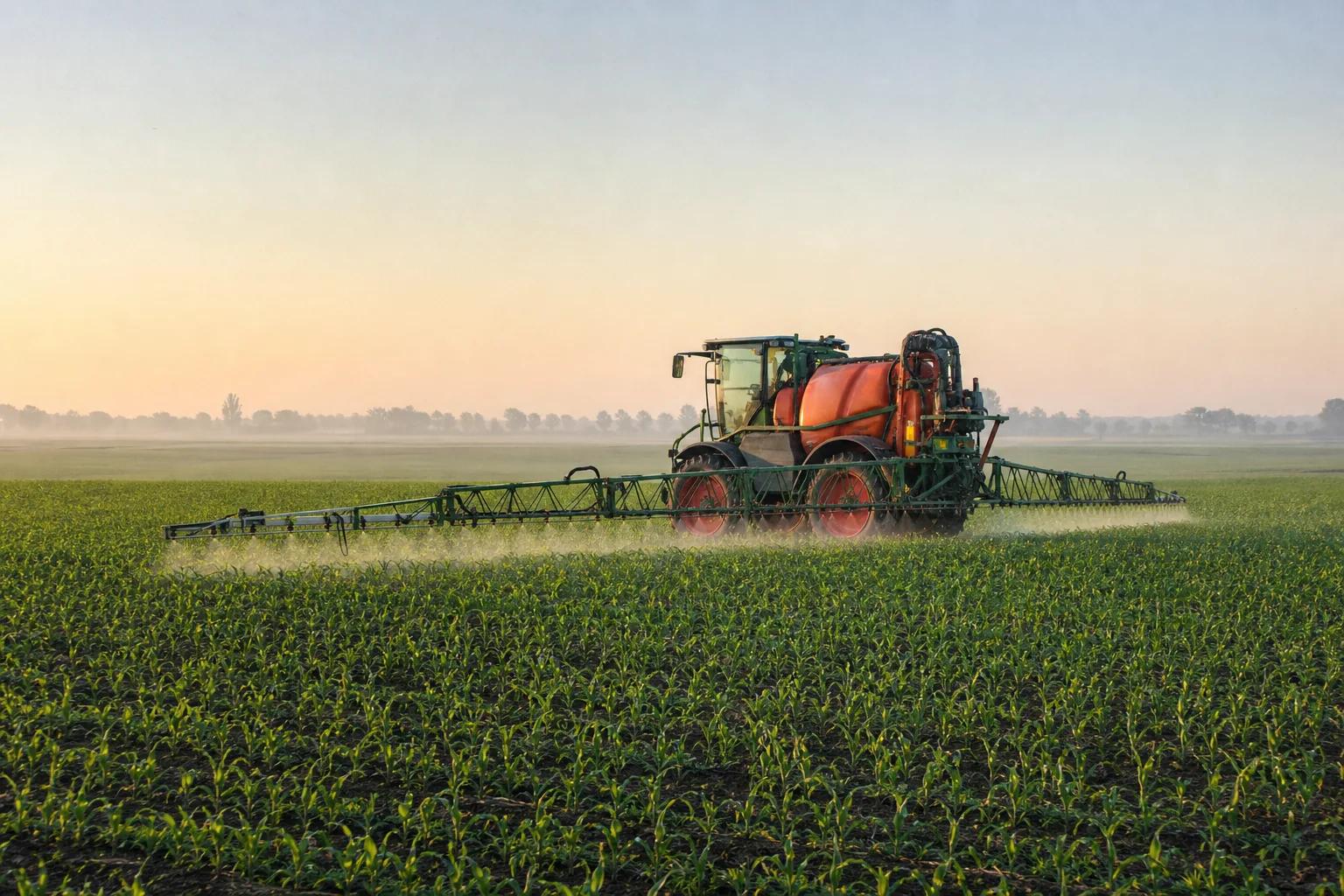
In short: it is worth spraying when, according to the label of the product, the wind is suitable, there is no temperature inversion, the temperature and humidity do not excessively accelerate the evaporation of the droplets, and the necessary rain resistance time is available before the expected precipitation. No single "good wind speed" or general waiting time can be applied to all agents and machines.
The five weather factors you should check before you leave
1. Wind speed and gust
Wind that is too strong can blow the drops off the target surface, but average is not the only thing that matters. Due to the changing direction and strong shocks, a part of the application may end up in a ditch, on a neighboring crop or towards a residential area. Measure on site, at the typical height of the application, and also observe where the air movement is going.
2. Temperature inversion
On a clear, calm evening or around dawn, cooler air near the surface can be trapped under the warmer layer. In this case, the very fine drops do not mix upward, but can float for a long time. A warning sign is a complete silence of the wind, fog, smoke or dust near the ground, or if the smoke spreads horizontally.
3. Temperature and humidity
In warm, dry air, smaller droplets evaporate faster, so they can become lighter and more prone to drift. With some active ingredients, high temperatures can also increase the risk of scorching of the cultivated plant. Always read the specific limitation from the prescription of the product.
4. Oncoming rain
Precipitation that arrives too early can wash away the active ingredient; at the same time, precipitation may be part of the operation for certain products that act on the soil. Look at the probable time of the start of the rain, the expected amount and intensity, and then compare it with the rain resistance time on the label.
5. Leaf wetness and dew
On heavily wet leaves, the spray juice may dilute or run off, but with other treatments, slight moisture is not necessarily an obstacle. Check the condition of the target surface in the vegetation before starting the machine, don't just infer it from the meteorological data.
Practical decision sequence
- Read the label of the given preparation: dose, droplet size, wind limit, temperature, protective distance and rain resistance.
- Look for a predicted time window at least as big as the entire field management and the necessary rain-free time.
- Measure the wind on the field, look at the adjacent sensitive areas and select the conditions for interruption.
- When starting, make a note of the time, temperature, wind and humidity.
- Also check during application. If the wind turns or becomes gusty, rain is approaching, or there are signs of an inversion, stop and reassess the situation.
The most common mistakes
- "It's always good in the morning." Dew and inversion may be common in the morning.
- "If there is no wind, there is no drift." In an inversion, the floating spray cloud can also move later.
- "The chance is only 30%, it definitely won't rain." Prediction probability is not a guarantee; also look at the radar signal and the uncertainty.
- "Measuring the nearby station is enough." Due to the forest strip, topography and stock height, the field may have a different wind.
FAQ
Is it possible to spray in complete silence?
The complete silence of the wind is not automatically favorable either, because it can be a sign of a temperature inversion. In this case, fine droplets can remain floating and later move laterally. The wind and application requirements of the product label always take precedence.
How long does it take between spraying and rain?
Product dependent. The required rain resistance time is specified on the label or permit document; there can also be a significant difference between contact and absorbable preparations. Do not use a general number of hours for all drugs.
Is it enough to look at the hourly weather forecast?
It is a good starting point for planning, but on-site wind measurements and sky checks are also necessary before and during application. At the edge of the field and at the height of the plant stand, conditions may be different than at a remote station.
Source
Detailed practical guidance on the application risks of wind, inversion and precipitation is provided by Penn State Extension crop protection recommendation. In Hungary, always act according to the permit, the label and the current crop protection rules.
