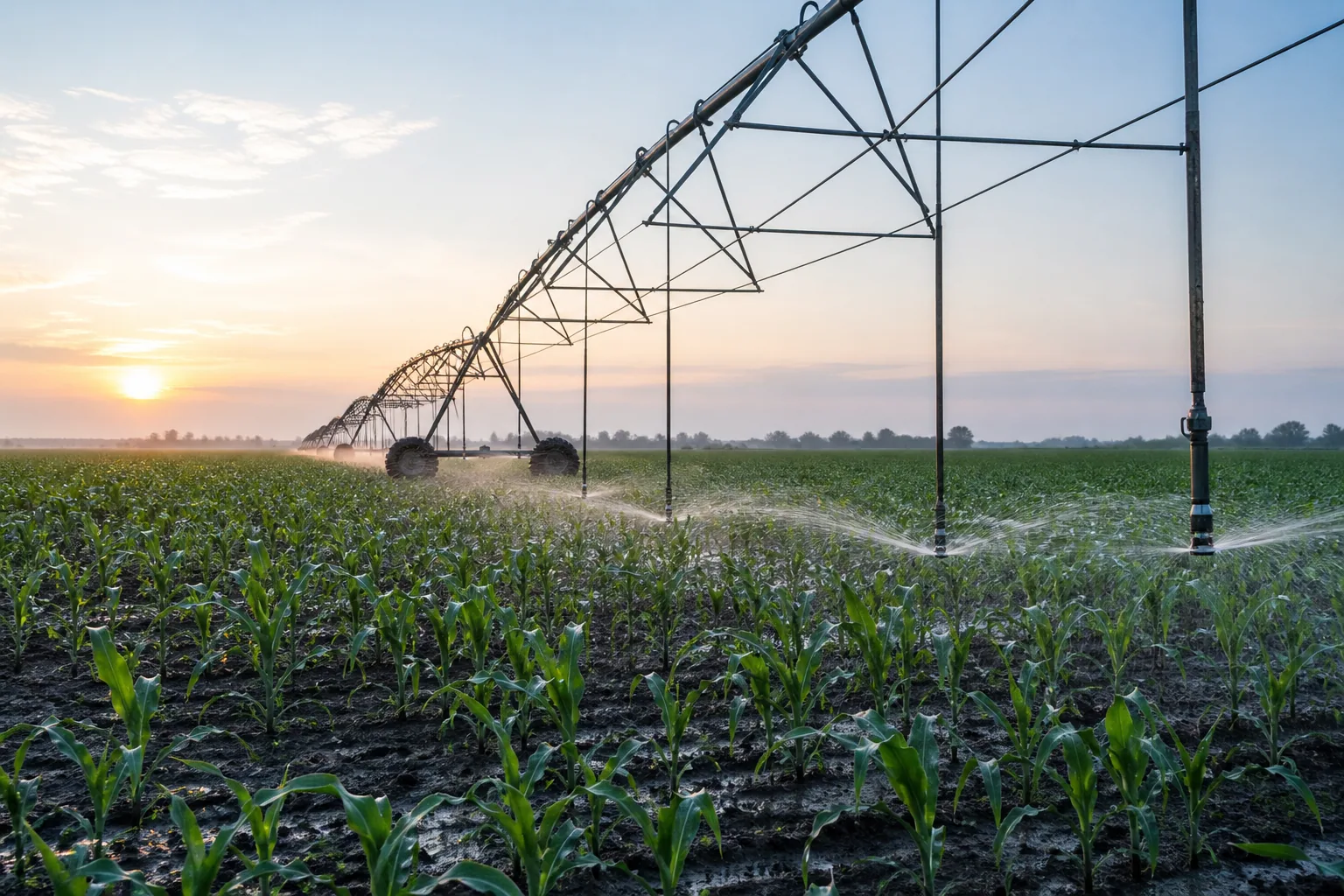
In short: watering is justified when the easily absorbed water supply of the root zone approaches a risky level for the crop — not simply when it is warm or the surface seems dry. A daily water balance, on-site soil inspection and short-term precipitation forecast provide a good basis for this.
The simplest idea of water balance
Water is removed from the root zone by evaporation from the plant and evaporation from the soil surface. Rainfall and irrigation add water. If more leaves than arrives, a water deficit accumulates:
today's water deficit = yesterday's water deficit + plant water use − effective rain − irrigation
In reality, runoff, seepage into the depths, and possible replenishment from groundwater also matter. The formula is still useful because it shows: millimeters of a shower cannot be automatically subtracted from the deficit, and the same warm day causes different water loss in a closed corn than in a newly sprouted stand.
What is evapotranspiration?
Evapotranspiration is a combination of soil evaporation and plant evaporation. The reference evapotranspiration is estimated from weather data, and then the effect of the crop and state of development is taken into account with a plant coefficient. In active growth, with a large leaf surface, the water requirement is typically higher, and may be lower at the end of ripening.
Therefore, it is misleading to work with the same weekly irrigation amount for an entire season. Root depth, foliage cover and the phenological period sensitive to water deficits are constantly changing.
Four data, without which it is easy to miss
- Soil water holding capacity: sandy soil stores less water and can drain faster; tighter soil can store more, but can absorb the intensive water dose more slowly.
- Current root depth: the plant only grows efficiently from the layer that its roots have already woven through.
- Development status: lack of water does not cause the same crop risk in every period. Flowering and fruiting are more sensitive than many crops.
- Effective precipitation: only the part of the measured rain remaining in the root zone actually reduces the deficit.
Practical morning inspection
- Look at the estimated water loss of the previous days and the most recent rainfall.
- Check the soil at several points, at several depths of the root zone — not just the top two centimeters.
- Look for early signs of plant stress, but don't wait for permanent wilting.
- See if rain is expected to realistically reach the root zone.
- Adjust the dose to the absorption capacity of the soil and the uniformity of the system.
When not to start automatically?
If significant rainfall is likely to occur within a short period of time, some of the irrigation may lead to runoff or loss beyond the root zone. Also reconsider the decision if part of the field is saturated with water, the plant is wilting due to root disease or compaction, or if strong wind would make the application very uneven.
The water balance model is an estimate. Regularly compare it with a soil moisture measurement or a manual soil test, and if you see a persistent difference, calibrate it to local conditions.
FAQ
How many millimeters of water should I dispense?
It is determined by the current lack of water in the root zone, the water-holding capacity of the soil, the state of development of the crop, the efficiency of the irrigation system and the expected rainfall. The goal is usually to replace the utilizable stock without runoff or deep seepage losses.
Is it better to water less often or more less often?
It depends on culture, soil and root depth. A shallow root system and low water storage capacity may require a more frequent dose, while a larger, less frequent dose may also be appropriate for a deeper root zone. The water released at one time should not exceed the capacity of the soil.
Can the water shortage always be reset after the rain?
Not. The foliage can absorb part of the precipitation, runoff can occur from intense rain, and the water that reaches beyond the root zone cannot be used. The effective precipitation is often less than the measured amount.
Source
The reference evapotranspiration, vegetation coefficients and soil water balance are FAO 56 Irrigation Guidelines is based on its principles. Always evaluate the model's estimate together with the local soil condition and the technology of the given crop.
