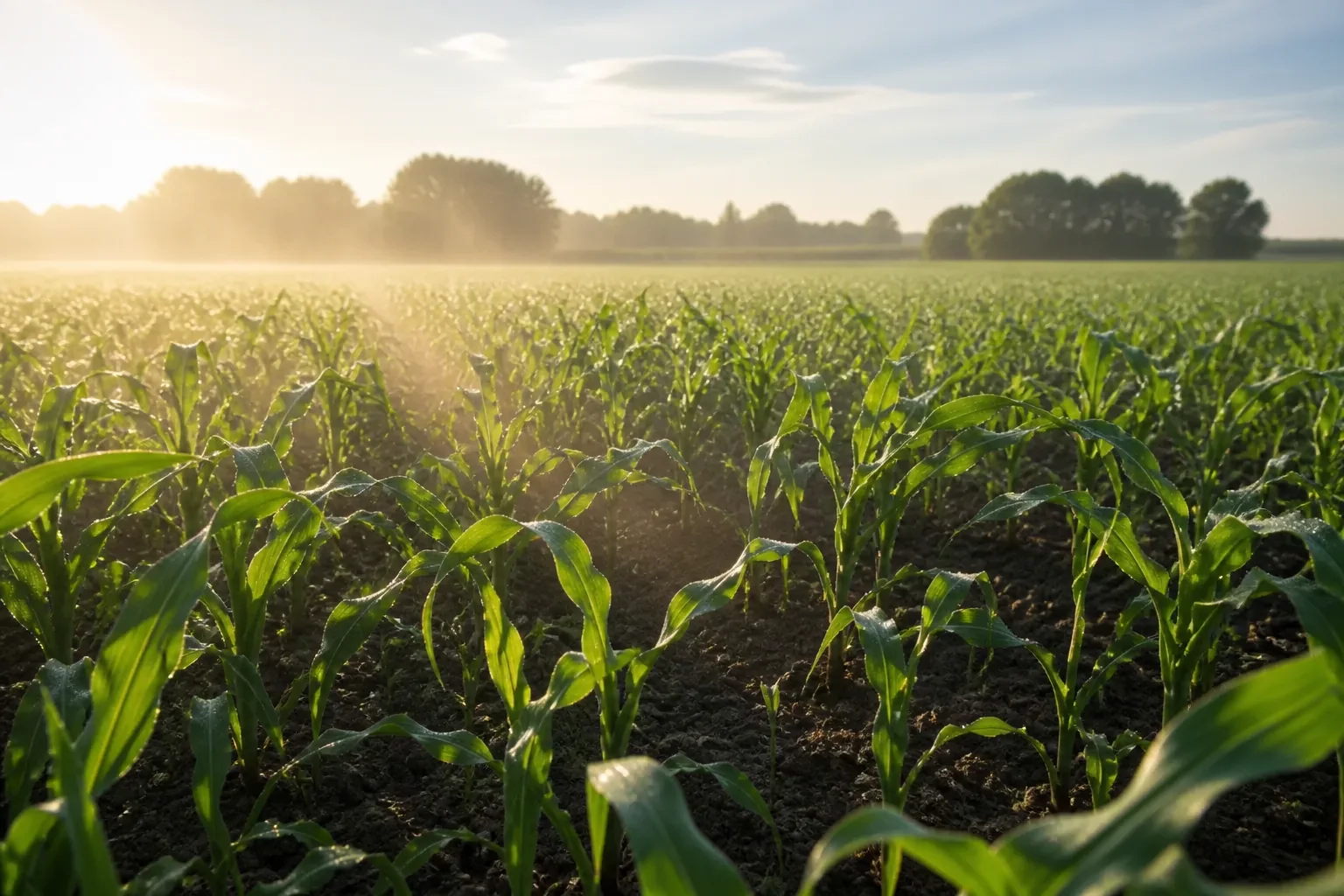
In short: evapotranspiration is the sum of soil surface evaporation and plant evaporation. It can be expressed in millimeters per day, so it can be directly compared to with precipitation and irrigation. However, the value estimates water loss and does not give a ready watering command.
What does evapotranspiration mean?
Water leaves the field in two main ways. The soil and wet plant surfaces evaporate water into the air, while some of the water absorbed by the roots leaves through the leaves. The former is evaporation, the latter is transpiration; the two together are evapotranspiration, ET for short.
ET is most strongly shaped by solar radiation, air temperature, humidity and wind. At the same time, the species of the plant, its development, its foliage, the moisture of the soil surface and the available groundwater also matter. For this reason, it is not possible to calculate reliable water use from the daily maximum temperature alone.
ET₀: evaporative demand of the weather
ET₀, or reference evapotranspiration, is the estimated evaporation of a well-defined, sufficiently watered reference surface. It is used to express the evaporating effect of the weather in a uniform way. Not corn, potato or fruit specific data.
The FAO Penman–Monteith method uses several meteorological variables to calculate ET₀. A sunny, dry and windy day will generally give a higher ET₀ than a cool, humid, overcast and windless day. This is true even if the maximum temperature of the two days is similar.
Kc and ETc: from benchmark to crop
The plant's estimated water use is given by the product of ET₀ and the plant coefficient:
ETc = ET₀ × Kc
Kc summarizes the influence of crop and state of development. After emergence, often lower on small leaf surfaces; closed, higher than active stock; it may decrease again as it approaches maturity. The Kc values in the literature are a starting point, because the local variety, sowing time, stocking density and cultivation technology can modify the real situation.
Why is the ETc not the same as the irrigation rate?
The plant first covers its daily water use from the stock of the root zone. If there is enough readily available water in the soil, supplementing ETc every single day may be unnecessary. The time and amount of irrigation is determined by the accumulated water deficit, the root depth, the water-holding capacity of the soil and the expected rainfall in the following days.
- Starting kit: how much water was in the root zone at the beginning of the calculation?
- Effective precipitation: how much of the fallen water seeped in and remained available?
- Water stress: in case of severe deficiency, the plant can reduce evaporation by stomatal closure, therefore the standard ETc may overestimate the actual water use.
- Technological loss: the applied water and the water stored in the root zone are not the same.
The practical use of the daily balance a when should you water? guide, and the field inspection is carried out by on measuring soil moisture is presented in an article about
Daily use: simple decision sequence
- Check the ET₀ source and whether it is a daily or hourly amount.
- Choose a Kc value that matches the crop and the real state of development.
- Keep the water balance in the root zone with effective rain and effective irrigation.
- Compare the estimate with the condition of the soil at least several times a week.
- In the event of a permanent discrepancy, do not "correct" the daily weather data, but review the root depth, soil parameter, Kc and the actual dose of irrigation.
FAQ
Is ET₀ the same as plant water demand?
Not. ET₀ is the weather-determined evaporative demand of a standard reference surface. For the estimated water use of the crop, this must be modified with a plant coefficient, i.e. Kc.
Should the value of ETc be poured in millimeters?
Not automatically. ETc is an estimate of daily plant water use. The initial water supply of the root zone, the effective rainfall, the absorption capacity of the soil and the losses of the irrigation system must be added to the irrigation dose.
Why does Kc change during the season?
Because the ground cover, the leaf surface, the height of the plant and the state of development change. A newly emerged stand and a closed canopy do not use the same amount of water under the same weather conditions.
Sources
The concepts and basis of the ETc = ET₀ × Kc approach are a FAO Irrigation and Drainage Paper 56. For the practical application of the daily water balance, further details are provided by University of Minnesota Extension's ET-Based Irrigation Guide.
