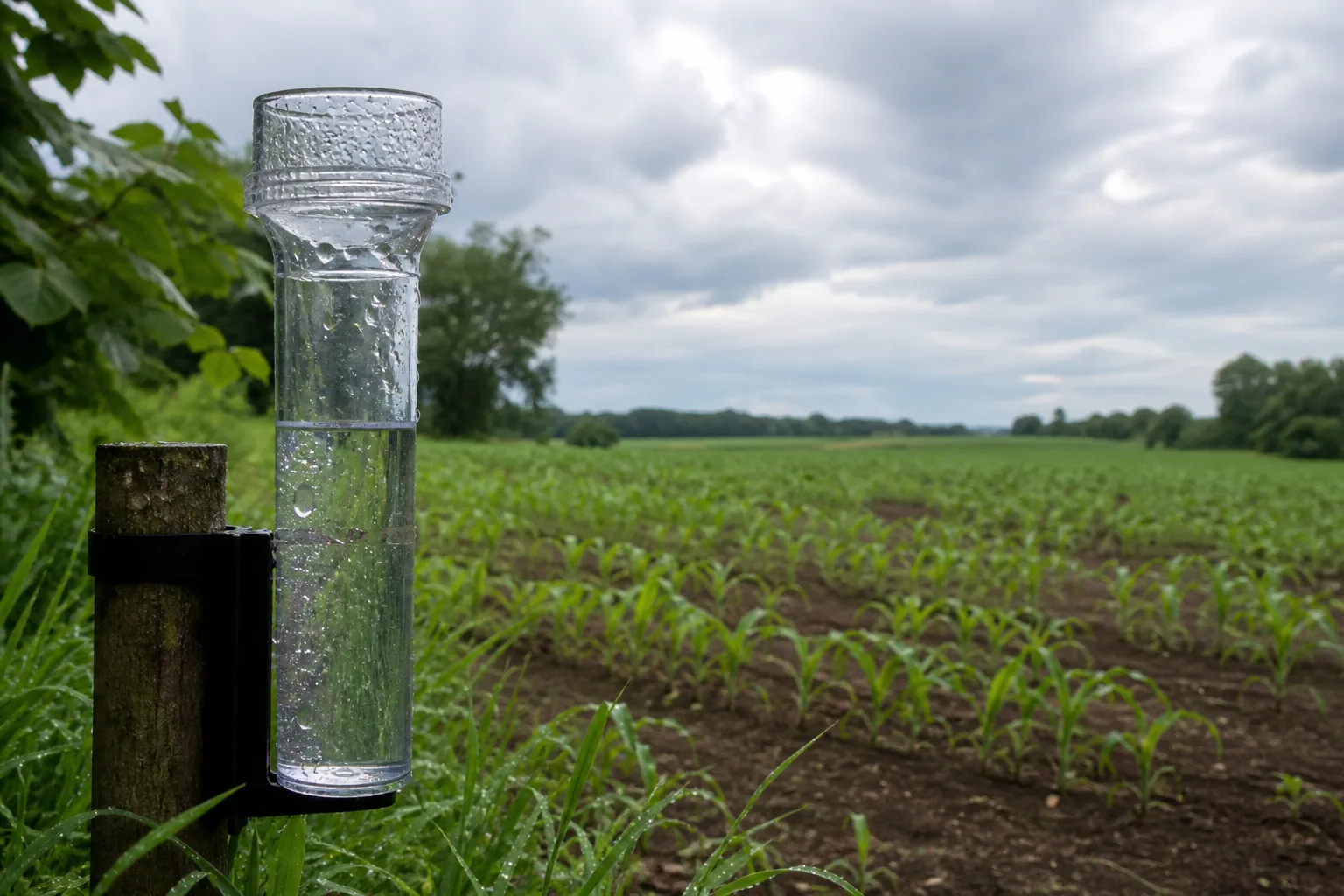
In short: 1 millimeter of precipitation means that a layer of water 1 millimeter high would collect on a flat, waterproof surface. This is it 1 liter per square meter, that is 10,000 liters per hectare. However, the water that has fallen is not the same as the water that is useful for the plant.
Quick conversions
precipitation volume = millimeters × area
- 1 mm of rain on 1 m² = 1 liter
- 1 mm of rain on 1 hectare = 10 m³ = 10,000 liters
- 10 mm of rain on 1 hectare = 100 m³ = 100,000 liters
- 25 mm of rain on 8 hectares = 2,000 m³ of water
The large number does not mean that it is all stored in the soil. If the surface is compact, sloping, or already saturated, some of the intense downpour may run off. On dry, crusty soil, short, intense rain can also be used worse than the same amount of water spread over several hours.
The conversion can also be used to control irrigation: 1 millimeter of actual water dose requires 10 cubic meters of applied water per hectare, even before system losses are taken into account.
How to place the manual rain gauge?
- Choose an open, representative place. Trees, buildings and tall vegetation can trap or swirl precipitation.
- The mouth of the meter should be horizontal. The slanted collection surface gives a smaller horizontal projection and therefore leads to incorrect results.
- Avoid splashing. Do not place it on the edge of a hard covering or roof where water can get in.
- Read it at the same time. For a daily amount, choose a fixed morning time and write down which 24 hours it applies to.
- Keep it clean. Insects, leaves and dust can partially block the inlet.
One meter does not always represent the whole field
In the case of frontal, uniform rain, the territorial difference may be smaller, but in the case of showers and thunderstorms, the amount may differ spectacularly within a few kilometers or even within a larger farm. Topography and wind can further increase the variety.
If the data influences an irrigation or crop protection decision, install several inexpensive meters. One should be at the plant center, and at least one on a field that is further away or has a regularly different microclimate. Check the alarming value with a radar image and the status of the meter.
What is effective precipitation?
Effective precipitation is the part that reaches the root zone of the plant and remains usable there. Reduces:
- water that stops on the foliage and evaporates from it;
- surface runoff;
- deep infiltration beyond the root zone;
- evaporation during and after precipitation.
Therefore, it is not always correct to reduce the calculated water deficit by exactly 20 mm after a 20 mm rain. Test the soil at root depth and see if there has been any ponding or erosional runoff.
FAQ
How many liters of water does 1 mm of rain mean?
It means 1 liter per square meter and 10,000 liters per hectare. This is the amount dropped; the part useful for the plant may be smaller due to evaporation, runoff and deep infiltration.
Can the millimeters of rain and irrigation be added?
As a measured amount, yes, but the part of them used in the root zone may differ. The intensity, application uniformity, soil moisture and infiltration capacity determine the actual replacement.
Why do two nearby rain gauges measure differently?
In a downpour, the rain can vary even within a short distance, in addition, wind, buildings, trees, slanted placement, splashing or partial blockage can cause measurement errors.
Source
The influence of the environment and placement of rain gauges is a fundamental part of meteorological measurement; additional materials a In the measurement knowledge base of the World Meteorological Organization are found.
