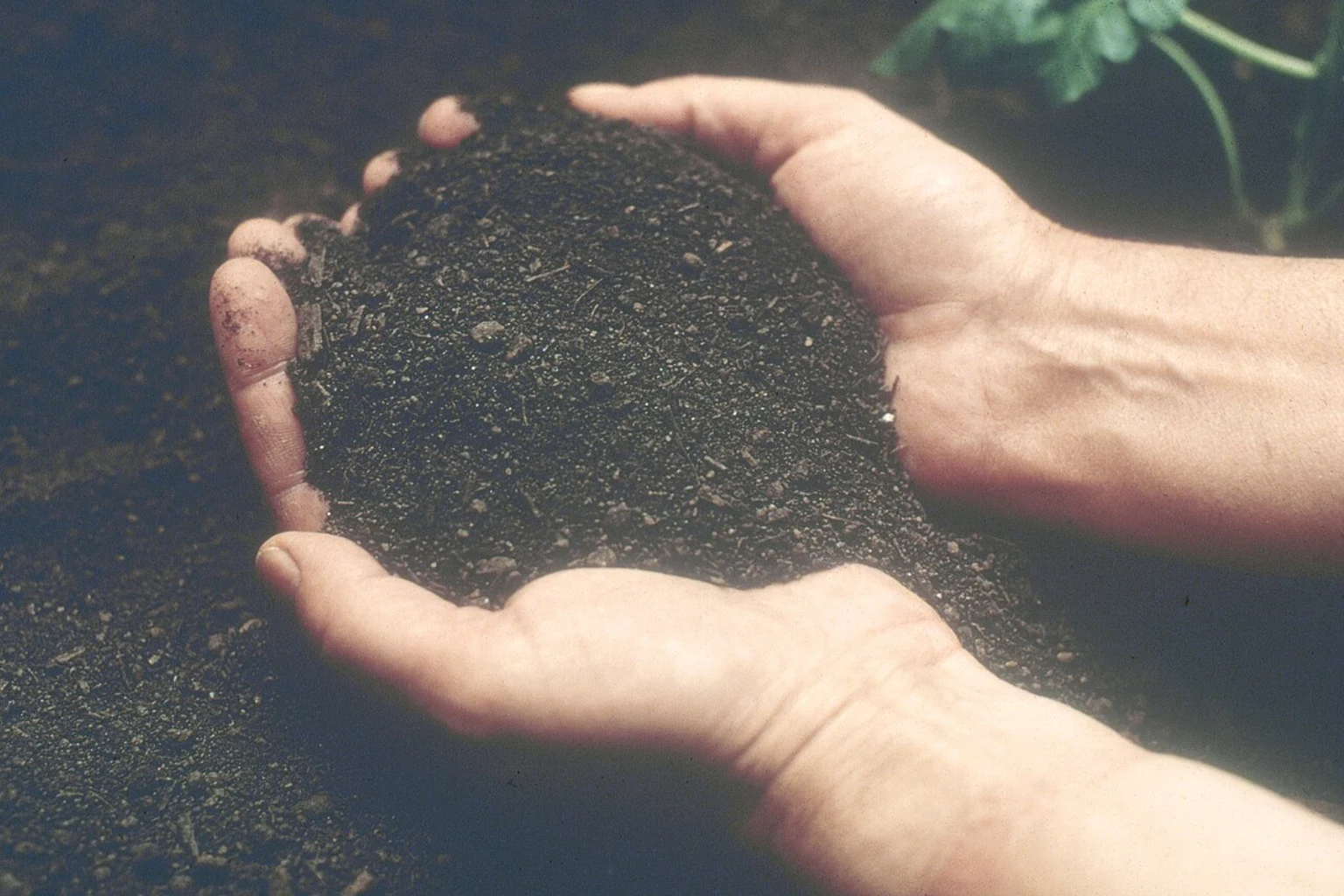
In short: do not decide from the color of the surface and not from a single point. Sample multiple depths of the plant's actual root zone at multiple characteristic locations. The manual tactile test is a quick check, and the well-installed sensor gives a continuous trend; stronger together than separately.
What do we really want to know?
When deciding on irrigation, the main question is not whether the top one or two centimeters of soil is wet. It is necessary to estimate how much easily absorbed water is left in the soil layer reached by the active roots. The surface can dry out quickly on a sunny, windy afternoon even if there is still adequate stock underneath; and after a short shower it may appear wet, while the water has not reached most of the root zone.
Moreover, soil moisture is not a single universal scale. The same volumetric water content in sand, loam and clay can mean different plant availability. Therefore, the metric should always be interpreted in conjunction with soil texture and local calibration.
Hand feel and look test
For the simplest method, take a sample with a spade or soil probe. Press it in the palm of your hand, try to form a ball or short ribbon, and observe the color, stickiness, crumbliness. Sandy soil is less cohesive even when wet; clay is more moldable; clay soil can form a longer, plastic band. For this reason, the same hand signal should not be applied to all soils.
- Take a sample from below the irrigated or rainfed surface, not just from the crusty top layer.
- Repeat in several depths of the root zone.
- Test at least one average spot, one quick-drying spot, and one deeper spot.
- Record the location, depth, time and time of the last rain or watering.
The method requires practice, but when used regularly it clearly indicates the direction of change. It is especially useful for checking sensor data: if the instrument and the hand sample permanently contradict each other, first check the installation, the soil-sensor connection and the measurement depth.
What do soil moisture sensors measure?
Volumetric water content
Capacitive, FDR or TDR type sensors estimate the water content from the electrical properties of the soil. Their advantage is frequent, automatic measurement. Their accuracy can be affected by soil salinity, temperature, structure, the air cavity around the sensor and the fit of the factory calibration to the local soil.
Groundwater potential or tension
The tensiometer and other potential-based devices approximate the suction force against which the plant can access water. This may be more directly related to the irrigation threshold, but the measurement range, maintenance and soil type are decisive here as well.
Where should the sensor go?
Even the most beautiful data curve is misleading if the sensor is in an unusual location. Do not install it exclusively on the edge of the field, in a compacted wheel track, in a recess or directly next to the dripper, unless you want to measure this extreme position. Mark the representative and risky zones separately.
- Upper root zone: it responds quickly to rain and watering, but also dries quickly.
- Central root zone: clearly shows the change in the main set used by the plant.
- Lower root zone: indicates whether the water reaches the desired depth or whether it reaches the useful layer.
This is how the measurement becomes a decision
First, determine the depth of the root zone and the estimated useful water holding capacity of the soil. Then link the intervention not to a momentary value, but to a locally controlled range and trend. Observe how long it takes for different depths to react after rain or irrigation, and then at what rate the stock is emptied.
The sensor does not replace the daily evapotranspiration and monitoring the expected precipitation, but it shows how well the calculated water balance matches the real field. The watering sequence is a water scarcity and timing guide sum up.
FAQ
How deep should soil moisture be measured?
In the current root zone of the crop, preferably in its upper, middle and lower parts. The fixed centimeter value in itself is not enough, because the root depth changes with the plant and the state of development.
Is a single sensor enough for a field?
Rarely. A sensor only measures its immediate environment. In the case of a different soil patch, relief situation or irrigation uniformity, it is worthwhile to designate a control point at least in a representative and problematic zone.
Which is better: volume percentage or soil suction?
They answer a different question. Volumetric water content estimates how much water is in the soil; the matrix potential or tension is rather how difficult it is to absorb. Their interpretation depends on soil type and calibration.
Sources
The steps and texture-dependent signals of manual estimation are described in a University of Minnesota Extension tactile guide details. About the sensor types, installation and irrigation use of the same institution soil moisture sensor summary provides a professional foundation.
