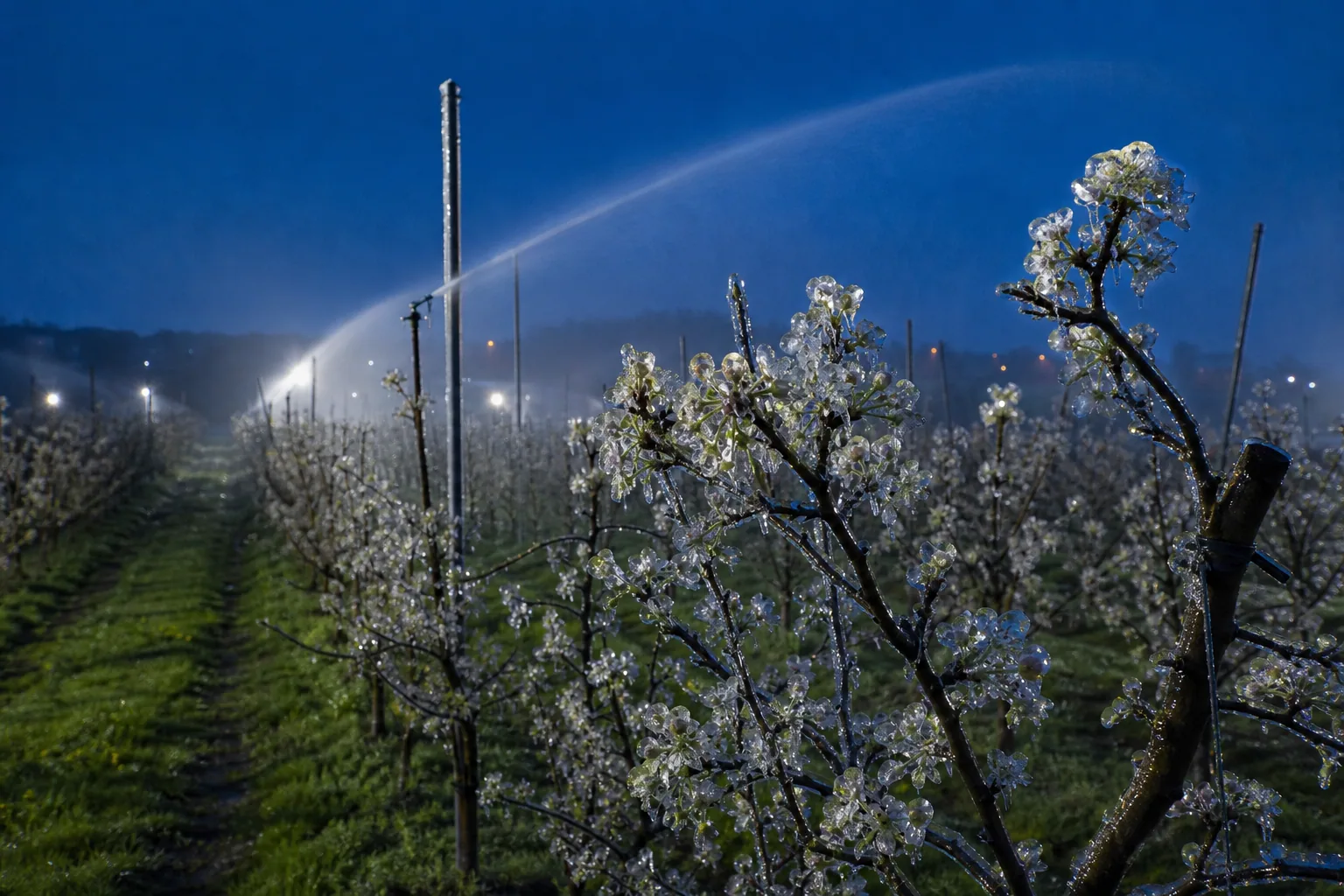
In short: frost protection irrigation must be started before the plant part to be protected reaches the damage temperature. The starting point is determined by the critical temperature of the crop and phenological state, and the wet-bulb temperature together — not a "0 °C rule" valid for all plantations.
1. First, determine what kind of frost is approaching
Radiation frost it mostly develops on a clear, weak windy night. The surface radiates heat, the air near the ground cools, and a temperature inversion can occur. In this case, a deeper part of the field can be much colder than the nearby meteorological station. This is the situation in which local measurement and knowledge of the topography are especially valuable.
Shipped frozen a cold, often windy air mass arrives. Strong air movement increases evaporation, takes away the released heat, and also worsens the distribution of the applied water. In such cases, the applicability of frost protection irrigation is highly system-dependent; operating limits for wind speed and water capacity must be followed.
2. Don't just look at the "telephone weather".
The regional forecast is a good early indicator, but not enough to start with. Prepare at least one shielded air thermometer at the plant height at risk, a wet-bulb temperature or humidity measurement if possible, and a control point in the cold part of the field. The sensor should not be next to a building, concrete, motor or direct water jet.
The dew point indicates how long the air can cool before it becomes saturated. At a low dew point, the air is dry: evaporative cooling may be stronger when watering begins. Therefore, a more usable startup variable is a wet-bulb temperature, which approximates the combined effect of air temperature and humidity.
3. Determine the critical temperature of the plant
There is no single "freeze damage temperature". The tolerance of dormant bud, swelling bud, opening flower and attached fruit set is different. In addition to the temperature, the damage also depends on the duration of the cold, the variety, the condition of the plant and the location of the measurement.
- Identify the crop, variety and current phenological state.
- Use the relevant critical temperature table from an authentic technology or expert consultant.
- Do not compare the standard two-meter air temperature directly to the temperature limit of the flower.
- Leave a safety time for the entire system to fill up and for the formation of a uniform water cover.
4. The practical decision line of the start-up
- 24-48 hours before: check the forecast minimum, dew point, wind and cloud cover. Try the pump, filters, nozzles and backup power supply.
- Before sunset: walk the cold spots, record the phenology, place the instruments, and calculate how long it takes each sprinkler to start.
- During cooling: don't just watch the current value, but also the hourly change. Rapid fall, low dew point and clear skies justify earlier readiness.
- Startup: based on the wet-bulb temperature limit prescribed for the crop and the ramp-up time of the system, start before the critical plant temperature.
- During operation: constantly check pressure, water coverage, wind and temperature. Ice alone does not prove that the plant is protected.
5. Why should it not be stopped prematurely?
The protection comes from the heat released when the water freezes. For this, new water must constantly reach the frozen surface. If application is interrupted while the environment is still freezing, plant tissue temperature can drop rapidly due to evaporation and further cooling.
The shutdown is not only linked to positive air temperatures. Wait until the wet-bulb temperature is permanently in the safe range, the ice begins to melt, and solar radiation or warming air provides more heat than the system shutdown can remove. Define the specific stop rule according to the local technology.
Night Checklist
□ The phenological state and the corresponding critical temperature are known.
□ There is a measurement on the part of the field most at risk of frost, at plant height.
□ The wet-bulb temperature or at least the temperature and humidity are known.
□ The pump, water supply, filters and all nozzles are checked.
□ You included the entire system startup time in the startup.
□ There is a person who supervises the system during the entire defense.
FAQ
Is it enough to monitor the air temperature?
Not. Plant tissue in radiation frost can be colder than air measured at standard altitude. The wet-bulb temperature, dew point, wind, cloudiness, rate of cooling and the phenological state of the plant together provide a usable picture.
Why is it dangerous to start watering too late?
The heat released when the water freezes only protects the plant with continuous and adequate water coverage. If the plant surface has already cooled below the critical temperature, evaporative cooling at start-up can further worsen the situation.
Can it be stopped as soon as the air rises above zero degrees?
Not necessarily. Application should be continued until the risk of new ice formation is eliminated, the ice begins to melt, and the wet-bulb temperature rises safely. The technological requirements of the local system and crop are primary.
Resources and further reading
The critical temperature varies by crop and developmental stage; gives a good summary of the University of Minnesota Extension Frost Protection Guide. Always plan the intervention in conjunction with the manufacturer's specifications of your own irrigation system and local expert advice.
