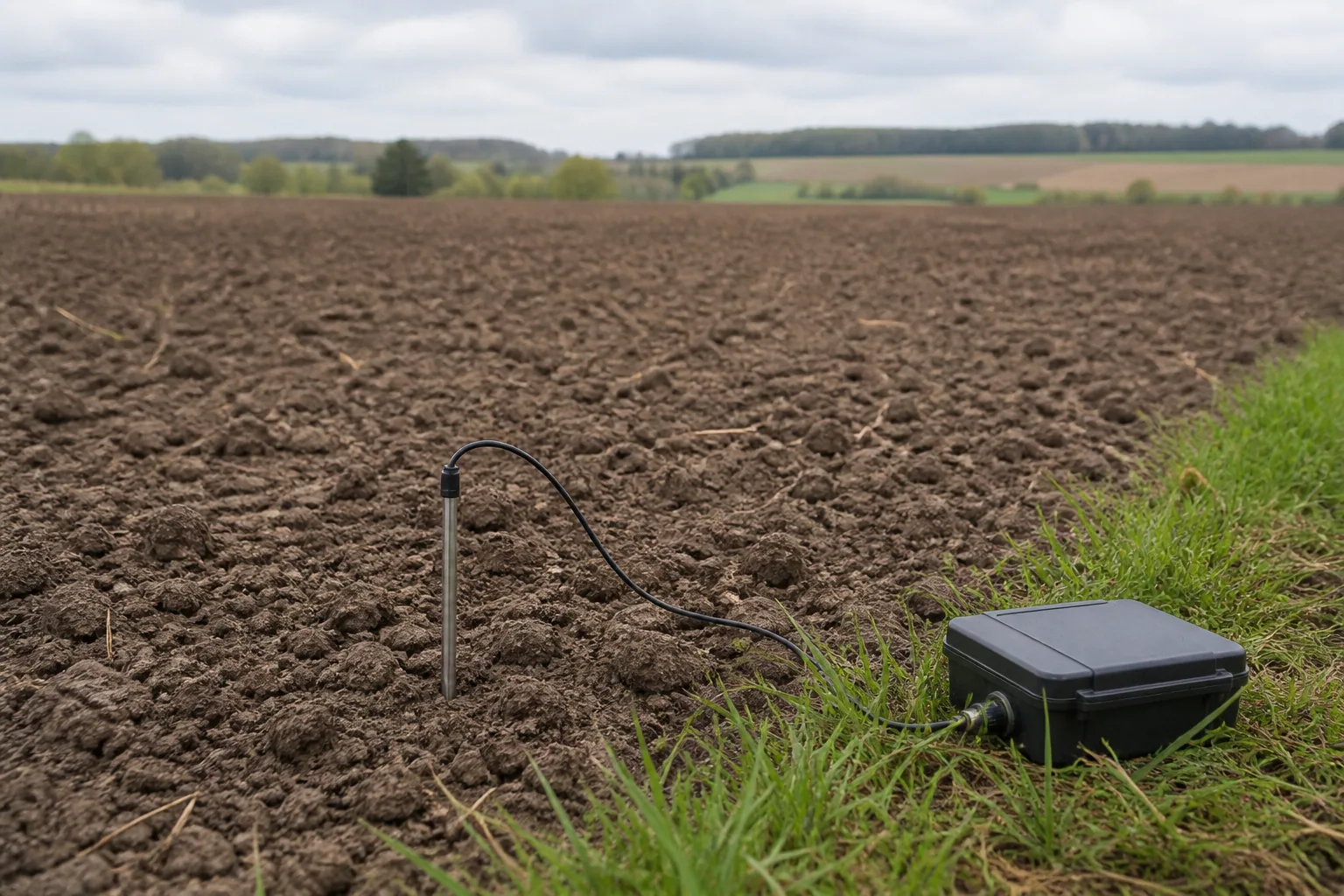
In short: always measure at the planned sowing depth, on a representative part of the field, at the same time of day and over several days. Do not look for a single "minimum temperature": the needs of the species and variety, soil moisture, the weather for the next few days and the duration of the warming all count together.
Why is the soil temperature different from the air temperature?
The soil absorbs heat during the day and releases it at night. How quickly it warms and cools depends on moisture, structure, color, plant residue, slope exposure and measurement depth. A dark, dry, bare surface can heat up quickly in the sun, while remaining noticeably colder a few centimeters below.
Therefore, it is misleading to infer the sowing temperature from the predicted maximum of the air. The core is affected by the temperature and water supply of the soil around it, not the air measured at two meters.
This is how you can make a comparable measurement
- Choose a location: do not measure on the edge of the field, in wheel tracks, puddles or unusually bare spots. On a heterogeneous field, choose a separate point for the tighter, looser, deeper and higher part.
- Measure sowing depth: place the sensor part of the probe where the core will be. The insertion should not leave a large air cavity next to the sensor.
- Wait for setup: wait for a stable value according to the instrument's user manual. Work with the same instrument and method.
- Repeat: perform several measurements even within one point, then look for the reason for the extreme value, do not automatically average it.
- Record conditions: without time, depth, feeling of moisture, cover, previous crop and the weather of the previous day, the value can hardly be interpreted later.
When is the soil considered "warm enough"?
On the Internet, you often see a single seeding threshold per crop. This can be a good reference point, but it is not enough in itself. The biological lower limit of germination is not the same as the range favorable for rapid, uniform germination. The variety, vigor of the seed, mowing, sowing depth and especially the water status of the soil modify the risk.
Decision questions that can be used:
- Will the morning value rise over several days, or are we just seeing a warm afternoon?
- Is the moisture at the sowing depth adequate for germination, but is there no airless, water-saturated condition?
- Will the next 5-7 days show cooling or heavy precipitation?
- Have the colder zones of the field also reached the desired state?
- Is there an advantage to sowing early that offsets the risk of slower emergence?
What does the difference within the field tell you?
A hilltop and a depression, a sandy patch and a clay patch, as well as a covered and bare surface can heat up at different rates. This is not necessarily a measurement error: it is often a real management zone. If the heating is regularly delayed in the same place, it is worth checking the moisture, compaction and surface drainage separately.
The estimation made from satellite, meteorological and soil data helps you to find these differences and see the trend in time. The on-site measurement will tell you whether the area can really be sown on the given day. The two are not competitors, but checks on each other.
Three common measurement errors
1. Measure on a sunny surface, too shallow
The upper few millimeters react quickly to solar radiation. If the core is 5 cm away, the surface peak value does not describe its environment.
2. Check only the hottest part of the field
A dry patch with southern exposure gives a "good" number sooner. Make the decision based on the typical and risky parts of the area you want to cultivate.
3. Treat temperature separately from humidity
A cold, water-saturated seed bed and a warm but dried-out seed bed can also be problematic. The temperature data must always be interpreted together with the soil condition.
FAQ
How deep should the soil temperature be measured?
Before sowing, it is worth measuring at the planned sowing depth. If you are comparing two crops that can be sown at different depths, measure both depths separately; the surface data is not a substitute for the temperature of the core environment.
Is one morning measurement enough?
It can be useful for a decision, but it does not show a trend. Measure at the same location and depth at least in the morning and in the afternoon on several consecutive days. When sowing, the lasting condition is more important than the peak value of a sunny afternoon.
Can the online estimate be used without an on-site measurement?
Yes, for comparing fields and monitoring trends, but before sowing or other costly interventions, it is worth checking with a cheap stick thermometer. Estimation and local measurement together form a stronger basis for decision-making.
Resources and further reading
Soil temperature also fundamentally affects root growth and germination; the difference according to depth is a FAO Soil Description Guide also discusses. When making a crop-specific sowing decision, the current recommendation of the seed distributor and local expert advice should always be the priority.
