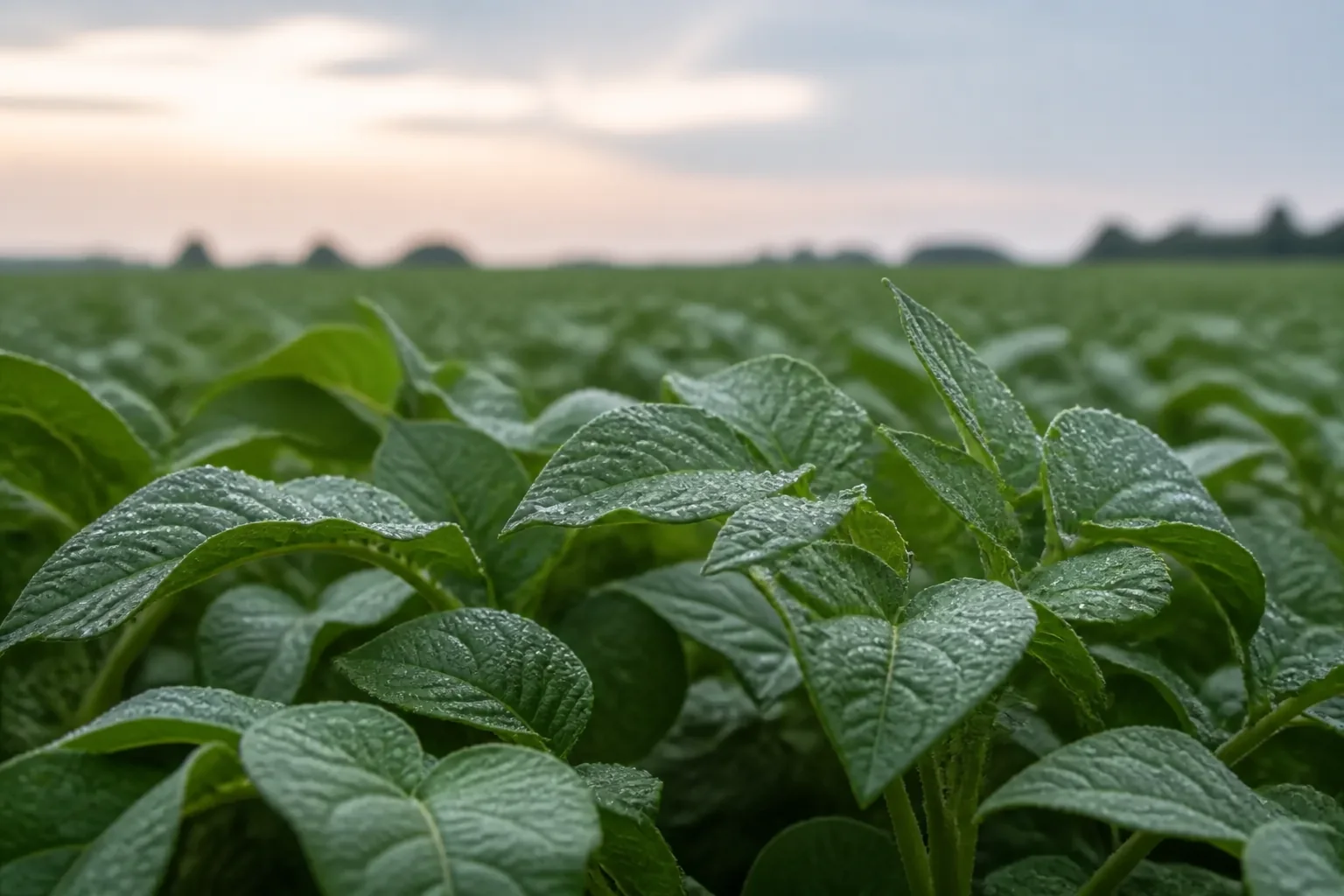
In short: leaf wetness indicates whether there is a liquid film of water on the surface of the plant and how long it remains there. It can be created by rain, dew, fog or irrigation hitting the foliage. The risk of many plant diseases depends not only on millimeters of rainfall, but also on the length of the wet period and the temperature during it.
What is leaf wetness?
A leaf is considered wet when there is continuous or partial liquid water on its surface. It can be a clearly visible raindrop, fine dew or a thin, barely noticeable film of water. From the point of view of the pathogen, the point is not necessarily the origin of the water, but how long the moist environment necessary for infection exists.
"Wet hours" generally refers to the duration of a continuous wetting event. If the foliage dries for a short time and then gets wet again, the rule of a specific disease model decides whether the two periods can be combined. Because of this, total wet hours per day and longest continuous wet period do not always mean the same thing.
Foliage can be wet even without rain
- Dew: on a clear, weak windy night, the leaf can get colder than the air and reach the dew point.
- Fog and low cloud: small drops of water may accumulate on the plant, especially on exposed or higher parts.
- Water film after rain: after the precipitation stops, the inside of the dense foliage can slowly dry out.
- Sprinkler irrigation: directly wets the foliage; with evening timing, the wet period can coincide with the night dew.
Therefore, it is misleading to judge the risk of infection solely from the amount of daily precipitation. A dewy night measuring less than a millimeter can provide longer foliage moisture than a quick daytime shower, after which the stock quickly dries up in sunny, windy weather.
Why do you have to look at the temperature?
The number of wet hours required for germs to germinate and penetrate depends on temperature. In the middle of the favorable range, a shorter period of moisture may be sufficient, while in cooler or too hot conditions it may take longer, or the infection may not occur at all. The exact threshold varies from disease to disease and plant to plant.
For example, some scab models assign the required number of hours to the average temperature during wetting. Other models also take into account high humidity hours, rainfall, phenological conditions or the presence of the infectious agent. A general rule of "8 hours of moisture = danger" is therefore not applicable to all crops.
How can it be measured or estimated?
With leaf wetness sensor
The sensor detects the presence of water on an artificial surface. Placement is critical: foliage height, angle, orientation, and location within the vegetation will change when it gets wet and dry. The sensor on the edge of the field, in the open air, can dry out faster than the inside of the closed stock.
From weather data
Model can estimate moisture from precipitation, humidity, dew point, radiation, wind and expected leaf temperature. This can cover a large area without a separate physical sensor, but uncertainty remains due to local fog, irrigation and foliage structure. It is worth checking the estimate with field experience or a periodic meter.
What can it be used for in practice?
- For targeted field scouting: after a long wet period with a favorable temperature, you can take the affected field forward.
- To schedule watering: if possible, avoid combining irrigation with evening dew into a long wet period.
- To check the spray window: on wet foliage, the decision must be made on the basis of the product's label, adhesion, rain resistance and the purpose of application; see the spraying weather conditions.
- As input to a disease model: for risks like potato blight, the duration of moisture is only one part of the entire chain of infection conditions.
The indication does not prove the presence of the pathogen and does not replace symptom identification, the crop protection forecasting network, the authorization document of the preparation or the decision of a specialist consultant.
FAQ
Is high humidity the same as leaf wetness?
Not. High relative humidity can favor dew and slow down drying, but there is not necessarily liquid water on the leaf surface. Some models use a humidity threshold as an approximation, but this is not the same as direct moisture sensing.
Does every wet leaf mean infection?
Not. Infection requires a susceptible plant, a pathogen present, the right temperature and moisture for a sufficient period of time. Leaf dampness is a risk condition, not a diagnosis.
With the end of the rain, does the leaf wetness also end?
Often not. A film of water on leaves, dense stands, low winds and high humidity can maintain moisture for hours after rain.
Sources
An example of the combined use of leaf wetness and temperature is a UC IPM Severity of Disease Table, and the location dependence of the sensor is a UC IPM Disease Model Database emphasizes. A fruitful example is a Penn State Extension's Guide to Infestation Seasons shows the practical tracking of wet hours.
